Trend Watch

The trends worth trying (and how to wear them)

Try Any Trend With One Piece Before You Believe the Hype

2026-07-24

Quick Answer: Test a trend by buying exactly one piece, wearing it with clothes you already own, and tracking whether you reach for it over 3–4 weeks. If you wear it 5+ times unprompted, invest further. If it hangs unworn, you learned that for the price of one item instead of a closet.

Trends arrive loud. The pressure is to either dive in with a full haul or dismiss the whole thing as ridiculous.

Both are guesses. One is just an expensive guess.

There’s a third option that people who dress well have been quietly running for years: treat the trend as a hypothesis and test it with a sample size of one.

Try Any Trend With One Piece Before You Believe the Hype

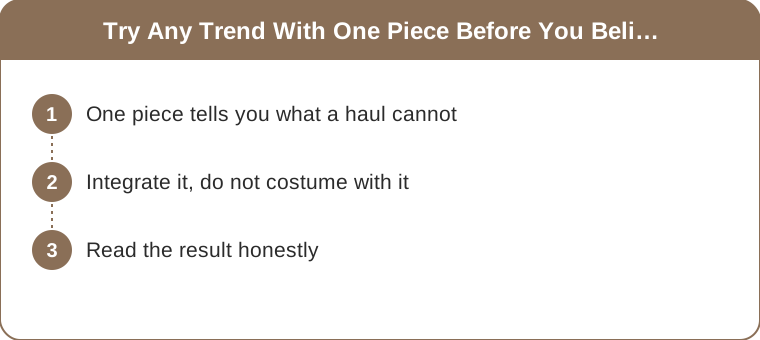
At a glance

Why does one piece tell you more than a haul?

Because a haul answers the wrong question.

Buying three or four pieces of a trend at once tells you that you like it in theory, on a model, at 11pm. It tells you nothing about whether it suits your coloring, works with your commute, survives your laundry habits, or still appeals in week three. And it usually ends with two items worn once and a vague sense of regret.

One well-chosen piece, worn against a wardrobe you already trust, produces actual data:

  • Does it suit you? Not the trend in the abstract — this cut, this proportion, on you.
  • Does it fit your life? A dramatic sleeve is a different proposition if you carry a toddler or type all day.
  • Do you reach for it after the novelty burns off? This is the only question that matters, and it takes about three weeks to answer.

One piece is a cheap experiment with a clear result. A haul is an expensive bet placed before any evidence exists.

Try Any Trend With One Piece Before You Believe the Hype

How should I wear the test piece?

Integrate it. Don’t costume with it.

Fold the trendy item into outfits built from clothes you already rely on — your good jeans, your best knit, the boots you wear constantly. Then watch whether the new piece elevates that base or fights it.

This does two useful things at once. First, it tests the trend in the actual context of your style rather than in a fantasy version of it. Second, it protects your money: a trend piece anchored to classics stays wearable even after the trend cools, because the outfit was never about the trend.

Here’s the sharp version of the test: a trend that only works as a head-to-toe look isn’t a trend you can wear — it’s a trend you can attend. If the piece needs three other trend pieces to make sense, it failed before you started.

Give it four weeks, and set the bar at wearing it at least five times without forcing yourself.

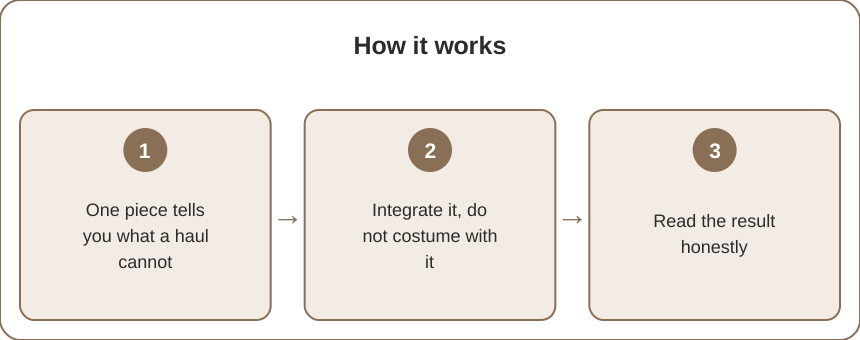
How it works

How do I read the result honestly?

After three or four weeks, the experiment reports back. Your only job is to read it without ego.

If you keep reaching for it — it comes out of the wash and goes straight back into rotation, it plays well with three or four different bases, you’ve stopped thinking of it as “the trendy one” — the trend earned a bigger place. Invest further, knowing it fits your life.

If it’s hung unworn, or if it only ever looked right in the mirror and never in your actual day, the trend wasn’t for you. That’s not a failure. You bought that information for the price of one item.

The trap is the middle case: the piece you wore twice, felt fine about, and keep meaning to style properly. That’s a no. “I’ll figure it out eventually” has never once been followed by figuring it out. Move it along and reclaim the hanger.

5 Mistakes Everyone Makes When Trying a Trend

  1. Buying the extreme version first. Trends have a spectrum. Start at the wearable end — the moderate proportion, the muted colorway. You can escalate later.
  2. Testing it at the peak price. Early-cycle trend pieces carry a hype premium. Waiting six to eight weeks often cuts the price 30–40% for the same item.
  3. Styling it only with other new things. That’s not a test, that’s a mood board.
  4. Judging it on day one. Novelty makes everything feel exciting for 48 hours. The signal is in week three.
  5. Skipping the exit. Decide in advance what “it failed” looks like, or you’ll rationalize forever. This is the one people never do, and it’s why closets fill up.

FAQ

How do I know if a trend will suit me before buying?

You mostly don’t — that’s the point of the one-piece test. But you can improve your odds: check whether the trend’s core proportion resembles anything you already wear happily, and try the piece on with a top you own rather than the store’s styling. If it needs the store’s entire outfit to look right, it won’t survive at home.

How long should I test a trend before deciding?

Three to four weeks of normal life. That’s long enough for the novelty to fade and for a couple of laundry cycles to reveal whether the piece is genuinely convenient. Anything shorter and you’re measuring excitement, not habit.

Accessories, color trends, and activewear — all low-commitment. A trend-colored high waist yoga pant or a new legging silhouette costs a fraction of a trend coat and gets worn 3–4 times a week, so you get your answer in ten days instead of a month. Squat-proof leggings in an of-the-moment shade are a genuinely low-risk way to find out whether a color belongs in your life.

What if the trend passes the test but then goes out of style?

That’s fine, and it’s why you integrated rather than costumed. A piece anchored to classic basics keeps working long after the trend cycle moves on — it just stops being “trendy” and becomes something you own.

TL;DR

  • One piece, not a haul — a cheap experiment beats an expensive bet
  • Wear it with clothes you already trust, never as a full trend look
  • Give it 3–4 weeks and a bar of five unprompted wears
  • Start at the wearable end of the trend’s spectrum, and wait out the hype premium
  • Decide your exit in advance — “I’ll figure it out” never happens
  • Either outcome is a win: you found a keeper, or you learned cheaply

Trends demand an all-or-nothing answer. Don’t give them one — run the experiment instead.

Keep Reading

This article is for general styling and informational purposes only. Trends, sizing, availability and pricing may vary by brand and season.

how to test a trendtrying trends one piecetrend without commitment

← All articles