The Trend Lifecycle: When to Buy In, When to Sit Out
Quick Answer: Every trend moves through the same four stages — runway, early-adopter, mass saturation, discount rack — and the smart move is auditioning cheap early, never buying investment pieces at peak saturation, and exiting the moment it hits the clearance rack.
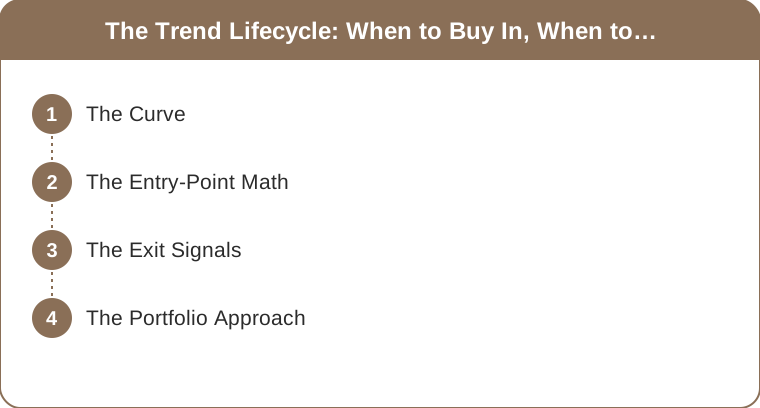
Every trend runs the same lifecycle — runway, early adopters, saturation, discount rack, nostalgia — and the buying decision is really a timing decision. Most people buy the same way at every stage of a trend’s life, which is exactly why they end up with a closet full of things that felt exciting for six weeks and dated for the following two years.

What are the actual stages of a trend’s lifecycle?
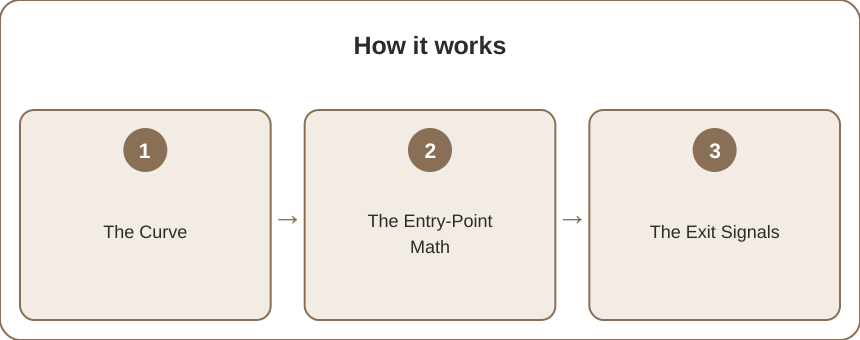
Four, roughly: the runway-and-editorial origin (12+ months from street reality), the early-adopter street phase (the trend at its most interesting, before it’s everywhere), mass saturation (every retailer, every price point — the peak), and the descent (the discount rack’s arrival is the official announcement that the wave broke). Each stage calls for a different action; the mistake is treating all four the same way.
When should you actually spend money on a trend?
Not at the peak — that’s the one rule worth tattooing on your shopping cart. Early entry is the fast-fashion audition: cheap, low-commitment, a genuine test of whether the trend and you actually get along. If it clicks, the quality version can follow. Peak entry is fine for accent-tier pieces (a $15 scarf, a cheap hair clip) but wrong for anything you’d call an investment — the saturation price premium buys you the shortest possible remaining runway before the trend ages out.

How do you know a trend is already over?
Watch for three signals: the discount-rack census (a trend at 60% off is the wave visibly breaking), your own saturation fatigue (the moment a piece starts reading “everywhere” instead of “interesting,” your eye is early data — trust it), and the personal sunset rule (when a trend piece stops earning its spot in rotation, it’s time to retire it or fully commit to wearing it past its moment). Wearing something past-trend is either dated or signature, and confidence decides which one it reads as.
5 Mistakes Everyone Makes With Trend Timing
- Buying investment-tier at peak saturation. You’re paying full price for the shortest remaining shelf life.
- Skipping the cheap audition phase. Jumping straight to a $200 version of something you’ve never actually worn is a gamble, not a strategy.
- Ignoring your own uniform. A trend that contradicts the outfits you already reach for daily was never really your trend — sitting it out is a styling decision, not falling behind.
- Panic-buying at the discount rack. By the time it’s marked down, the trend has usually already broken — you’re buying the tail end, not a bargain.
- Treating every piece the same. A trend accent (jewelry, a scarf) and a trend statement (a coat, a full silhouette) deserve completely different entry-point strategies.
What Nobody Tells You About Trend Cycles
Trends genuinely repeat — most operate on roughly 20-year orbits. That piece you archived isn’t dead weight; it’s a future re-entry with vintage credibility built in. The keep-box earns its shelf space precisely because trends were always weather, and your closet just needs a climate that can handle any forecast.
FAQ
How do you decide if a trend is worth an investment purchase?
Only invest once you’ve cheaply auditioned the trend and confirmed you reach for it often — and only while it’s still in the early-adopter phase, before saturation drives prices up and remaining lifespan down.
Should you buy a trend at 70% off?
Usually no, unless it’s a genuine accent piece — a steep discount typically means the trend has already peaked and is on its way out, not that you’re getting ahead of it.
Is it ever okay to wear something after its trend has passed?
Absolutely — that’s the difference between “dated” and “signature.” Confidence and consistent styling turn an off-trend piece into a personal look rather than a fashion misstep.
Can a trend re-enter its early-adopter phase after cycling out?
Yes — trends on roughly 20-year cycles often re-emerge with a fresh audience treating them as new, which is exactly why archived pieces sometimes regain relevance without you changing anything.
TL;DR:
- Trends move through four stages: runway, early-adopter, saturation, discount rack
- Audition cheap early; never buy investment pieces at peak saturation
- Watch the discount rack and your own fatigue as exit signals
- Trends cycle back roughly every 20 years — the archive box has real value
Does social media speed up the trend lifecycle?
Considerably — trends that once took a full season to reach saturation can now peak within weeks online, which makes the cheap-audition-first strategy even more valuable than it was a decade ago.
Read the stage, audition cheap, invest never at peak, exit on saturation. Trends were always timing problems — the lifecycle map just posts the schedule.
Keep Reading
This article is for general styling and informational purposes only. Trends, sizing, availability and pricing may vary by brand and season.